

When the Universe Burned: The Untold Story Behind the Kanwar Yatra
The world was dying. And only one being had the courage to swallow death itself.
The world was dying. And only one being had the courage to swallow death itself.
Every year, as the monsoon clouds gather over the Indian subcontinent, something extraordinary happens. Millions of men, women, and even children—dressed in saffron, barefoot, with bamboo poles slung across their shoulders—begin walking. They walk for days, sometimes weeks. They walk through scorching heat and pouring rain. They walk until their feet crack and their backs ache.
They are the Kanwariyas. And the water they carry is not just water. It is salvation.
But to understand why they walk, you must first understand a story so ancient, so cosmic, that it predates humanity itself. A story of gods and demons, of poison and nectar, and of a god who chose to suffer so that the universe could survive.
This is the story behind the Kanwar Yatra.
The Churning of the Cosmic Ocean
In the beginning of time, the Devas (gods) and the Asuras (demons) were locked in an eternal struggle for power. But even gods cannot live forever. They needed the nectar of immortality—Amrita—to regain their strength and defeat their enemies.
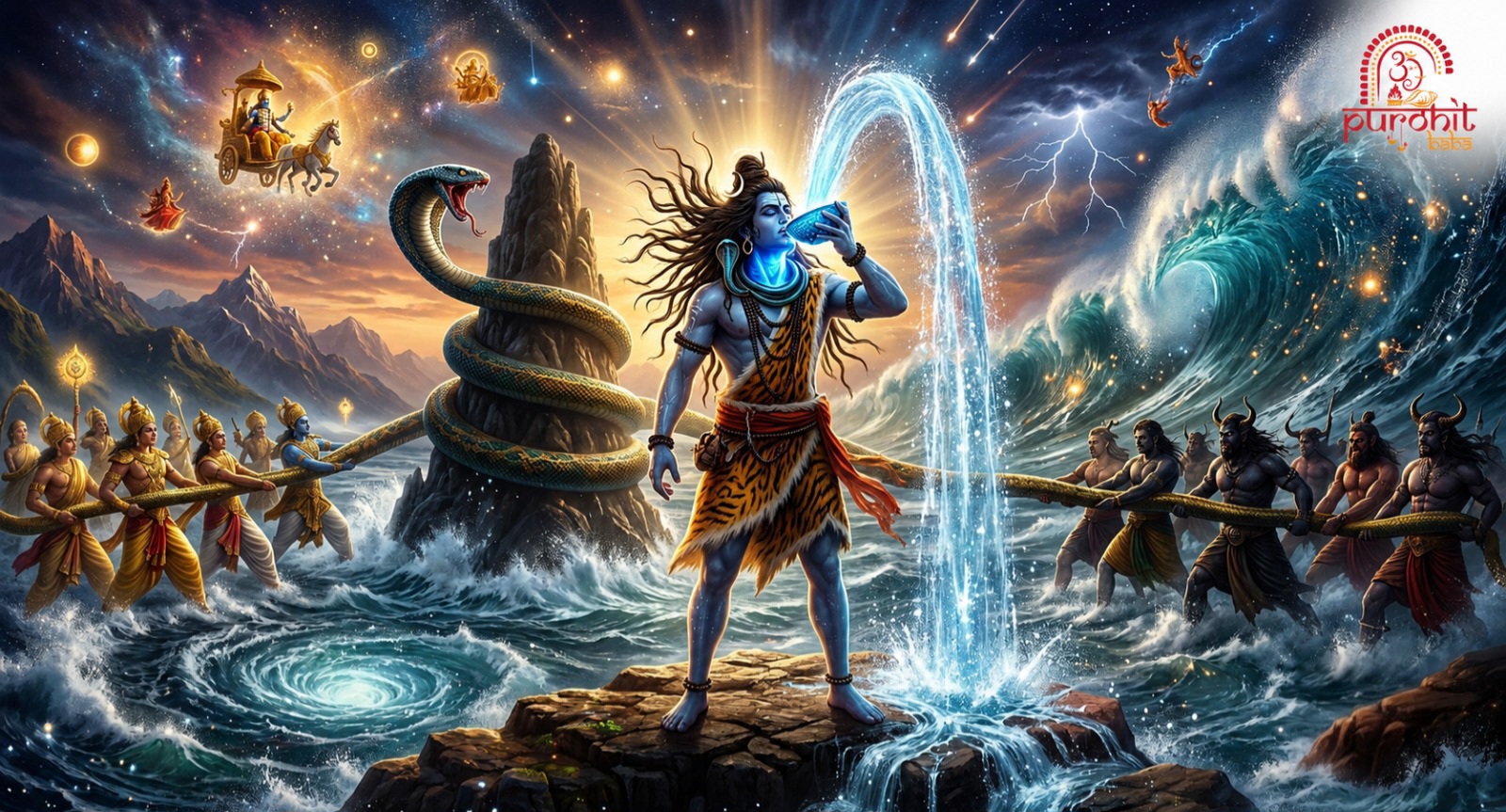
So they made a pact. Together, they would churn the cosmic ocean, the Kshira Sagara, to extract the Amrita. They used Mount Mandara as the churning rod and the mighty serpent Vasuki as the rope. The Devas held one end of the serpent, the Asuras the other. And they pulled. And pulled. And pulled.
For a thousand years, they churned the ocean. Mountains crumbled. Oceans roared. The universe trembled.
And then, something emerged from the depths.
It was not nectar. It was not treasure. It was Halahal—the most lethal poison the cosmos had ever seen. Dark, smoking, and alive with malevolence, it rose from the churning ocean like a serpent of smoke, spreading through the air, poisoning everything it touched. Trees withered. Rivers turned toxic. The gods and demons began to choke, their divine bodies burning from within.
No one could touch it. No one could stop it.
The universe was dying.
The Sacrifice of Neelkanth
Desperate, the Devas and Asuras turned to the only being powerful enough to face such destruction: Lord Shiva.
They begged him to save them. And Shiva, the destroyer of worlds, the lord of compassion, did something that defies all logic. He drank the poison.
He did not swallow it—that would have killed him instantly. Instead, he held it in his throat, trapping the venom in his neck. The poison was so potent that his throat turned a deep, midnight blue. From that moment on, he was known as Neelkanth—the one with the blue throat.
But the poison was not without consequence. A burning sensation raged in his throat. His divine body convulsed with pain. The heat of the Halahal was unbearable, and it threatened to consume him from within.
The gods, witnessing their savior's suffering, rushed to find a cure. They brought water from the holiest of rivers—the Ganga—and poured it over Shiva's throat to cool the burning poison. The water hissed and steamed as it touched the venom, but slowly, mercifully, the pain began to subside.
And so, a tradition was born.
The First Kanwariyas: A Question of Legends
Who, then, was the first Kanwariya? Who first carried the holy water to cool the burning lord?
The scriptures offer no single answer. Instead, they give us three extraordinary candidates—each one a legend in his own right.
🪓 Lord Parashurama: The Warrior Sage
According to one belief, the first Kanwariya was Lord Parashurama, the sixth avatar of Vishnu and an ardent devotee of Shiva. After a tragic incident where he was forced to behead his own mother at his father's command, Parashurama was consumed by guilt. To atone for his sin, he undertook intense penance before a Shivalinga.
Every Monday during the month of Sawan, he would walk from Garhmukteshwar to the Pura Mahadeva temple in Uttar Pradesh, carrying Ganga water to offer to Lord Shiva. His devotion was so great that Shiva blessed him, restoring his mother to life and granting him the divine axe—the parshu—that would become his eternal symbol.
If you believe this story, Parashurama was the first to walk the path that millions now follow.
👹 Ravana: The Demon Who Loved Shiva
Then there is Ravana—the demon king of Lanka, the ten-headed villain of the Ramayana. But Ravana was not just a demon. He was one of Shiva's greatest devotees.
The story goes that after Shiva drank the Halahal poison, his throat burned with unbearable pain. Ravana, who worshipped Shiva with unwavering devotion, could not bear to see his lord suffer. He filled a kanwar with holy Ganga water and poured it over Shiva's throat at the Pura Mahadeva temple.
In that moment, Ravana became the first Kanwariya.
But Ravana's connection to the Kanwar Yatra does not end there. Legend has it that Ravana once performed such intense penance to please Shiva that the lord blessed him with a sacred Shivalinga. Ravana was instructed to carry it to Lanka, but on the way, he had to place it on the ground to answer nature's call. When he returned, the linga had become immovable, permanently rooted to the earth.
That place is now known as Deoghar. And the linga is worshipped as Baba Baidyanath—one of the twelve Jyotirlingas.
🏹 Lord Rama: The Exile's Offering
And then there is Lord Rama, the seventh avatar of Vishnu, the hero of the Ramayana.
Some scholars trace the Kanwariya tradition back to the Treta Yuga, when Rama, along with Sita and Lakshmana, was wandering the forests during his 14-year exile. During his journey, Rama arrived at the sacred site of Sultanganj in Bihar, where the Ganga flows northward—a rare and holy phenomenon. He filled his kanwar with the north-flowing Ganga water and carried it to the Shivalinga at Babadham (now Deoghar), offering it to Lord Shiva.
Some believe that Rama was the first to perform this sacred ritual, and that his act of devotion set the precedent for millions to come.
The Modern Yatra: Faith on Foot
Today, the Kanwar Yatra has grown into something unimaginable. It is no longer a small pilgrimage of saints and sages. It is India's largest annual religious gathering.
In Haridwar alone, an estimated 30 to 45 million devotees participate each year. The yatra, once a humble affair, exploded in popularity in the late 1980s and has not stopped growing since.
🛕 The Deoghar Route: 105 Kilometers of Devotion
The most famous Kanwar Yatra route leads to Baba Baidyanath Dham in Deoghar, Jharkhand. Devotees begin their journey at Sultanganj in Bihar, where the Ganga flows northward. Here, they take a holy dip in the river and collect water in brass or clay pots, which they suspend from bamboo poles balanced across their shoulders.
Then, they begin to walk. 105 kilometers barefoot. Through forests, over hills, across highways, under the scorching sun and the pounding monsoon rain. For days, they walk without rest, their feet raw, their bodies exhausted, but their spirits unbroken.
Along the way, they chant "Bol Bam!" —a thunderous cry that echoes through the hills and valleys. They wear saffron, the color of renunciation, and many observe strict vows—fasting, celibacy, and silence.
Upon reaching Deoghar, they bathe in the sacred Shivganga pond, purify themselves, and finally offer the water to the Jyotirlinga. It is the culmination of days of suffering—and in that moment, all the pain dissolves into pure, unadulterated joy.
Believed to be the world's longest religious fair, the Shravani Mela draws 5 to 5.5 million pilgrims each year.
The Haridwar Route: 45 Million Devotees
Meanwhile, in the north, Haridwar becomes a sea of saffron. Millions of Kanwariyas converge on the ghats of Har Ki Pauri, where the Ganga descends from the mountains into the plains. From here, they collect water and carry it to Shiva temples across Uttar Pradesh, Delhi, Rajasthan, and beyond.
The scene is overwhelming. The air vibrates with the sound of "Bam Bam Bhole!" The ghats are packed with devotees, some walking, some dancing, some carrying their elderly parents on their shoulders. The devotion is raw, unfiltered, and deeply moving.
Why Do They Walk?
The Kanwar Yatra is not just a ritual. It is a reenactment of the greatest sacrifice ever made—Shiva drinking the poison to save the universe. When a devotee carries Ganga water to a Shivalinga, they are not just offering water. They are offering cooling relief to the burning lord.
They are saying: "You suffered for us. Now, let us suffer a little for you."
It is also a journey of purification. The barefoot walk is a form of penance, a way of shedding ego and materialism. The hardships—the blistered feet, the exhaustion, the hunger—are offerings in themselves.
And the rewards? Devotees believe that offering water to Shiva during Sawan absolves sins, fulfills wishes, and brings them closer to salvation. Many pray for progeny, for health, for peace. Some walk to honor a vow made in a moment of crisis. Others walk simply because their parents walked, and their grandparents before them.
Purohit Baba: Bringing the Divine Closer
But let us be honest. Not everyone can walk 105 kilometers barefoot. Not everyone can take weeks off from work, leave their families, and brave the monsoon roads.
Does that make their devotion any less? Absolutely not.
At Purohit Baba, we believe that the divine should be accessible to everyone—whether you are walking the dusty roads of Sultanganj or sitting in a high-rise apartment in Mumbai.
This Sawan, we bring the sacred to you:
Online Jalabhishek – Our experienced priests perform the water offering on your behalf at Deoghar or Haridwar, with the same rituals and the same devotion.
Authentic Puja Samagri – Saffron, sandalwood, belpatra, Gangajal, and everything else you need for a perfect Sawan Monday puja—delivered to your doorstep.
Pandit Booking – Need a priest for a special Shiva puja at home? We connect you with verified Vedic scholars who bring the temple to your living room.
Kundli Milan – Because finding the right life partner—like Shiva found Parvati—requires more than just love. It requires cosmic alignment.
This Sawan, connect with Mahadev—whether your path is paved with bare feet or with a click.
👉 Begin your spiritual journey today: 🔗 PurohitBaba.com
Har Har Mahadev! 🙏
- सावन में क्या नहीं करना चाहिए ? जानें श्रावण मास के 15 महत्वपूर्ण नियम
- सावन में क्या करना चाहिए? जानिए श्रावण मास के शुभ कार्य और पूजा के नियम
- सावन 2026: कब से शुरू होगा, भगवान शिव को क्यों प्रिय है, धार्मिक महत्व, पौराणिक कथा और संपूर्ण जानकारी
यदि आप पंचांग अनुसार संकल्प, गोत्र उच्चारण और रुद्राभिषेक कराना चाहते हैं, तो
Online Pandit Booking | Pooja at Home | Havan | Puja Samagri | Kundli
यहाँ से पंडित जी ऑनलाइन बुक किए जाते हैं और वे घर पर आकर वैदिक विधि से पूजा सम्पन्न करवाते हैं।
PurohitBaba के साथ पूजा बुक करें।
इस सावन मास आप घर बैठे आसानी से पूजा बुक कर सकते हैं: Book Now
PurohitBaba की विशेषताएं:
- Verified Astrologers & Pandits
- Fixed Session Pricing (No Per-Minute Billing)
- Easy Online Booking
- Home Puja Service
📲 WhatsApp: 77177 76177
🌐 Visit: PurohitBaba.com